Friday, August 29, 2008

Friday's Top Five - Influential Fiction

Kyle Hopkins (Covenant's new English 12 teacher) and Justin Knapp (Covenant's favorite son) got me thinking a couple weeks ago when I posted my Top Five Influential Books list. Both of them mentioned fiction titles, which struck me as I hadn't included any on my list. Honestly, I found this odd, particularly since fiction is my favorite style of literature (though, it seems, I've been reading much more non-fiction lately - odd). Because of their influence, I give you my Top Five Most Influential Fiction titles:

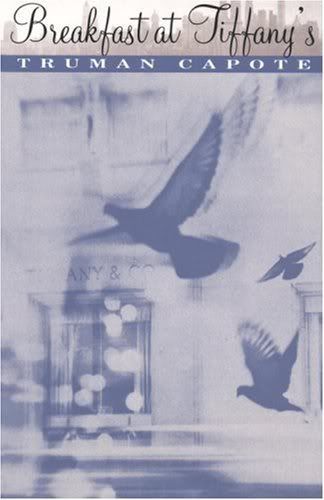
5. Breakfast at Tiffany's by Truman Capote
In Cold Blood was some of my first exposure to the writing of Truman Capote since I was forced to read his short story "A Christmas Memory" in middle school. (And, since I didn't like anything I read in middle school - because I was being forced to read it in middle school - it was a futile endeavor.) However, after reading In Cold Blood, I felt inspired to pick up some of Capote's other writings. Breakfast at Tiffany's was the first. I was amazed at Capote's use of prose - its poetic nature and fluid rhythm, almost as if it were a living thing in and of itself. I am consistantly enamored with his writing and think it a shame he didn't stick around to write more.

4. Brave New World by Aldous Huxley
I read Brave New World my senior year in high school and absolutely loved it! My reading of it followed my reading of Sir Thomas More's Utopia, Orwell's 1984, and Postman's Amusing Ourselves to Death, so I was already fascinated by the concept of dystopia - a society which seems perfect to a degree, but falls apart when the surface is scratched or upset in any way. Huxley BNW defied my prior notions of a dystopia largely because of its characters are unaware of the flaws inherent in the society. In his nightmarish vision, Huxley paints a society so close to the one in which we live, it's almost frightening.

3. American Gods by Neil Gaiman
I had heard Gaiman's name mentioned before, namely in comic circles as the author of the series The Sandman. Other than that, I knew nothing of him before I picked up American Gods one summer night during my high school days. One of the first things I noticed was that it was epic in scope. Indeed, the book had a cast in the dozens (with many more unnamed besides) and told a story that stretched across centuries and continents, written in a style that is at once self-aware and unassuming. Gaiman reveals himself a master story-teller in both this and its sequel, the novella The Monarch of the Glen. If you've not read either, do yourself a favor.

2. Alice's Adventures in Wonderland by Lewis Carroll
Like many, my first exposure to Carroll's wonderful creations was Disney's animated classic Alice in Wonderland. In fact, it wasn't until high school (when I read Carroll selections for speech tournaments) that I discovered the amazing text pieces the film had been based on - Adventures and its sequel, Through the Looking Glass and What Alice Found There. They were so different from Disney's version, which made them so compelling. With rich characters and oddly absurdist thinking, it became no wonder to me that Alice (and Carroll) had successfully captured the imaginations of so many for so long.

1. 1984 by George Orwell
No other book has elicited such a response from me. Read not for class but of my own volition (a rare feat for me in high school... at least with regard to a classic piece of literature), I found 1984 haunting, disturbing, and compelling. I connected well with its main character and, as such, was upset by the course of action within the book. A thinly-veiled indictment of Communism, Orwell's masterpiece has stood the test of time as a chilling work regarding both the role of government and free will.

Honorable mentions: Watchmen (Moore & Gibbons), The Reluctant Fundamentalist (Hamid), Waiting for Godot (Beckett), Sophie's World (Gaarder), Cat's Cradle (Vonnegut)

*NOTE* - I have actually not read Harper Lee's To Kill a Mockingbird, which I know is a literary heresy. It's on my list of "books to read," but know that it's exclusion on this list is mainly due to that fact.

So... what are some of your favorite fiction titles?

Friday, August 22, 2008

Friday's Top Five - Rock Guitarists

I love rock music, particularly the harder edged stuff of the pop/hair metal genre. Mostly, the stuff you'd find on any classic hits station. I really love to just crank the music and just go - particularly driving to and from work or church. I'm especially fond of any powerful guitar solos. Maybe it's my own jealousy at not being terribly musical, but I love them. So, I decided to compile a list of some of my favorite rock guitarists. These lists probably won't measure up to many you'd find online, but again, not being terribly musical, I just know what I like... and I like these guys.

5. Ace "Space Ace" Frehley (Kiss)
I've really been digging on Kiss lately, particularly their early stuff from before Frehley and drummer Peter Criss left the group. The stuff those four guys did together is unbelievable... and Ace held his own against the theatrics of Simmons. (Of course, when you're shooting fireworks out of your Les Paul, how can you not?) For a taste of what makes Frehley truly great, check out "2000 Man" from the Dynasty album. Classic!


4. Angus Young (AC/DC)
And speaking of showmanship, few guitarists can measure up to AC/DC's Angus Young! Decked out in a complete Catholic schoolboy uniform, Young prances across the stage as he plays, bringing adrenaline and charisma with him. And, while I've heard the guy's as dumb as a post, he can play guitar like few others in the rock world. Just check out the opening licks on "Thunderstruck" if you don't believe me. One of the classic guitar riffs that I always count among my favorite rock guitar intros ever.

3. Jimmy Page (Yardbirds, Led Zepplin)
I've only recently become interested in Zepplin, which many rock fans would undoubtedly consider a heresy. Oh, sure, I'd heard "Stairway to Heaven" before. Who hadn't? And Page's guitar in that song is unparalleled. And then I started getting into more of their stuff and finding out more about the artist known as Jimmy Page. What I learned, I loved! One of my particular favorites would have to be his solo toward the end of "Immigrant Song". Combined with lead singer Robert Plant's captivating vocals, Page's guitar packs a much more solid wallop!

2. Eddie Van Halen (Van Halen)
Say what you will about the politics of the band as a whole - Van Halen's guitar is solid! And while I'm a fan of a lot of Van Halen's stuff - from "Panama" to their cover of Roy Orbison's "Pretty Woman" - it's not hard to admit that the best part of listening to the band as a whole is listening to Eddie's electrifying guitar. "Eruption" is called one of the greatest rock guitar solos of all time... and for good reason. Eddie wails on that thing and leaves his audiences screaming for more. Truly brilliant at what he does!

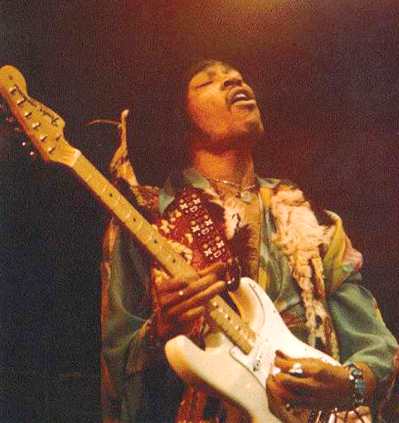
1. Jimi Hendrix (The Jimi Hendrix Experience)
As if anyone else really could be number one! Hendrix was a brilliant showman and completely revolutionized the way the guitar was perceived by the rock crowd. Most would point to his rendition of "The Star Spangled Banner" from Woodstock as the perfect example of this... and I think they'd be right to an extent. However, being the Dylan fan that I am, I think I'd be remiss if I didn't mention his version of "All Along the Watchtower" - a brilliant song made even more so when given that Hendrix touch. Amazing!

Honorable mentions: Slash (Guns N' Roses), Carlos Santana (Santana), Mark Knopfler (Dire Straits), Eric Clapton (Yardbirds, Cream, solo), Brian May (Queen)

Who are some of your favorite rock guitarists?

Thursday, August 21, 2008

Rantin' & Ravin': Is Originality a Liability?

Solomon perhaps said it best when he said, "there is nothing new under the sun" (Ecc. 1:9). I know that, to an extent, this is true - at its basic core, everything has been done before... but should that stop us from trying to be original?

This whole idea didn't exactly germinate overnight... but was definitely set off this morning. While driving into work, I had the radio going and thought I heard something familiar. Ah, yes - the opening piano of Warren Zevon's classic "Werewolves of London". But NOO-OO-OO! Instead, I was offered Kid Rock's "All Summer Long" which not only borrowed from the great Zevon, but also swiped the background vocals and guitar licks from Skynyrd's "Sweet Home Alabama". Much as I may enjoy the occasional Kid Rock song, I was appalled.

This isn't a recent trend either. And I suppose that's what aggravates me. It's been a major problem since Vanilla Ice added a DING! to the end of Queen's "Under Pressure" in order to create his hit (yes, singular), "Ice, Ice Baby". But it's an epidemic now. From Gwen Stefani's "Wind it Up" (taken from The Sound of Music's "The Lonely Goatherd") to Sean Kingston's "Beautiful Girls" (which borrows the bassline from Ben E. King's "Stand By Me"), from Rhianna's "S.O.S." (the chords from "Tainted Love" by Soft Cell can be heard in the background) to the aforementioned "All Summer Long"... it's almost like we're rewarding artists for not creating.

And it's not even just music either. Ever since the late nineties, movies are created that are remakes of old sitcoms or (worst of all) other classic movies from a bygone era. Do we really need two "Dukes of Hazzard" remakes? Or another Willy Wonka and the Chocolate Factory? Can anyone really top the original casts? Not really...

I find it very frustrating to live in a society that not only praises mediocrity but also lauds unoriginality. Where are the Grammys for Sufjan Stevens, Rufus Wainwright, or Iron & Wine? Where are the bands waiting to take up the mantles of Bob Dylan, Led Zepplin, and other people who actually wrote their own music?

Is originality a liability?

Feel free to discuss.

Friday, August 15, 2008

Friday's Top Five - Influential Books

Well, school has started and that means that life turns very busy very quickly. A lot of teaching and a lot of grading - and I've only been at it for two days! Boy, am I tuckered! Still, I'm going to try to keep up on this blog, even if it's just to post my regular features - Hot Topic Tuesday (which no one seems to read) and Friday's Top Five (which seems to be the most popular feature so far).

At any rate, since school has started, I wanted to post a list of the five books that have most influenced my thought over the last several years (some might call them the 'formidable' ones). These are books (and thinkers) that have shaped my thought and helped me formulate what I believe. (P.S. ~ I consider the Bible to be a given, so know that it ultimately trumps my #1 choice. Just know.)

5. "Beyond Good and Evil" by Friedrich Nietzsche
Falsely called the "father of nihilism,' Nietzsche has gotten a bad rep - particularly from the Christian community. Why? Because he wrote, "God is dead and we are the ones who've killed him." It mostly gets taken out of context. Nietzsche's statement is actually an indictment of the modern philosophical project, made popular by thinkers like Rene Descartes, who said "I think, therefore I am." In Nietzsche's mind, since human reason has replaced God, we have killed him... and the world now has a deep sense of hopelessness as a result. More than any other thinker, Nietzsche (through this book) has helped me understand the current state of the unsaved world at large.

4. "Desiring God" by John Piper
Piper hit me at a time in my life when I'd been asking a lot of questions, particularly about issues of faith. What did it mean to follow God? What is the difference between Calvinism and Arminianism and can it be the difference between heaven and hell? How the heck are we supposed to be joyful always?! Piper may not have answered all of these questions directly, but his book definitely gave me something to think about at a time when thinking about God was all I could do. For the first time, I began to think for myself and think outside the 'box' I'd constructed for myself. This was one of the first books I can say honestly 'changed my life.'

3. "The Knowledge of the Holy" by A.W. Tozer
I first read this book as a freshman in high school and found it quite enjoyable. Tozer explained something difficult, like the attributes of God, in a way that I could understand and in short, concise chapters, which I loved. I rediscovered it in college when I opted to read it as a Bible study with a girl I liked at the time. We never ended up reading it together, but I found myself enthralled as I re-read it. When I began teaching last year, this was one of the two books I decided to go through with my freshman for in-class devotions. I don't think they got a lot out of it, but I surely did!

2. "Confessions" by St. Augustine
One of the quintessential Christian classics, I would call "Confessions" the book every Christian should read before they die! Part autobiography, part devotional book, part philosophy/theology text, "Confessions" reads as a book by a man who has much to be thankful for - Augustine shares of all the major turning points in his life, his major sins, his conversion, and his life as a follower of Christ. Definitely a book I would recommend to anyone who asked me for something good to read!

1. "The Cost of Discipleship" by Dietrich Bonhoeffer
Next to the Bible itself, no book has shaped my current view of the act of being a Christian better than Bonhoeffer's essential work on what it means to be a "disciple". The whole idea of grace has, for me, been a constant source of wonder and (dare I say it?) amazement over the past three or four years. The difference between cheap and costly grace is staggering... yet I would imagine that most Christians would not even be able to discern the difference. Bonhoeffer pulls no punches and his work stirs and challenges. Definitely one for someone who has a question about what it means to truly serve God.

Honorable mentions: "Mere Christianity" (Lewis), "Fear and Trembling" (Kierkegaard), "Republic" (Plato), "Resident Aliens" (Hauerwas & Willimon), "The Politics of Jesus" (Yoder)

What are some books that have influenced and impacted you?

Tuesday, August 12, 2008

Hot Topic Tuesday - Christ & the American Dream

*NOTE* - I got this image from a blog called Rain and the Rhinoceros. Apt for what I wanna talk about today.

Christ & The American Dream

...or perhaps I should call it "Christ vs. the American Dream." This is one I've been contemplating over the past year or so. When I first began thinking about it, I couldn't help but think of how the concept of the American Dream seemed so contrary to what Christ has to say in Scripture.

(By the by, when I speak of the American Dream here, I'm talking more of its current meaning of material prosperity than I am of the right of every individual to live and work in freedom. Why? Two reasons. 1. There is nothing in Scripture that overtly contradicts the latter and 2. I've found the previous definition to be more culturally relevant in present society - which makes sense, given that it's the current 'going' definition.)

So, here's the question: What does Christ have to say about a topic like the American Dream?
  • Matt. 6:19-21 - "Do not store up for yourselves treasures on earth, where moth and rust destroy, and where thieves break in and steal. But store up for yourselves treasures in heaven, where moth and rust do not destroy, and where thieves do not break in and steal. For where your treasure is, there your heart will be also."
  • Matt. 19:23-24 - "I tell you the truth, it is hard for a rich man to enter the kingdom of heaven. Again I tell you, it is easier for a camel to go through the eye of a needle than for a rich man to enter the kingdom of God."
  • Matt. 6:24 - "No one can serve two masters. Either he will hate the one and love the other, or he will be devoted to the one and despise the other. You cannot serve both God and Money." (Some translations substitute 'Money' for 'Mammon,' an abstraction, a personification of material wealth. Mammon gained particular fame as a demon in John Milton's classic Paradise Lost.)
  • I Tim. 6:10 - "For the love of money is a root of all kinds of evil. Some people, eager for money, have wandered from the faith and pierced themselves with many griefs." (Yes, I know these were the words of Paul and not of Christ, but Paul himself encourages others to follow his example as he followed Christ's - I Cor. 11:1. I would encourage you, however, to read the whole passage (vv. 3-10). Most people just know that verse - and not accurately, I might add - and I think the whole thought is an important one.)
This is of course to say nothing of Christ's view on taxes (Matt. 22:15-22) or on giving (Mark 12:41-44) or any of the other various teachings throughout Scripture on the same or similar topics. The Bible has much to say on money and the harm that can come from it.

And I think that we, as Christians, should be cognizant of that. Does that mean we shouldn't have money? By no means. What I think it points to is a question of stewardship.

Dictionary.com defines a 'steward' as "a person who manages another's property or financial affairs; one who administers anything as the agent of another or others" (italics added). By definition, a steward is not an owner of any particular thing. Americans are obsessed with possessions (or, as my high school friend Josh Bernardin once said, "We long for possession, not possessions" - implying that we only want; the object of our want is secondary), but the joke is on us - we own nothing!

Read through Psalm 50 if you get a chance. Verse 10 is a pretty popular one (at least one that I've heard repeated often), but the entire passage speaks of God's lack of need for sacrifices - it's already His! If you or I 'have' anything, it is on loan from its Original Owner.

What does that say about us as Americans? Should our concern be for our own wellbeing? Obviously, I think we need to be taken care of... but what of those who are less fortunate? Consider James 1:27 or Acts 2:45. Or, possibly even more condemning, check out the Book of Amos!

Amos was a shepherd from Judah (the southern kingdom of Israel) called to give testimony against Israel (the northern kingdom). At this time, Israel was going through something of a Golden Age - they were amid several trade routes and were doing quite well for themselves. However, while they were prospering economically, they were dying spiritually. Sin had not become taboo, theoretically from the presence of so many foreign (read: pagan) influences. They were a living example of what Dietrich Bonhoeffer called "cheap grace" - it didn't matter how many times they sinned; they'd just up and sacrifice an animal and start all over again!

Amos 4 is a stinging rebuke. Amos calls the women 'cows,' claiming that they oppress the impoverished and make demands from their husbands (a cultural no-no in ancient Israel). God's response to their behavior? "The time will surely come when you will be taken away with hooks, the last of you with fishhooks" (Amos 4:2). Ouch!

Ultimately, the northern kingdom was subjagated by the pagan nation of Assyria, to be followed only a few years later by Judah (who were taken by Babylon). These things happened as a result of them turning from God and His law.

"So... what exactly are you saying, Stephen?" I hear you ask from afar.

America is a great nation... but it is a nation consumed with consumption. We desire material wealth to great extent. And, often, it can consume our focus to the point where the things we should be focusing on (i.e. the Kingdom of God - Matt 6:33). It is difficult for a rich man to enter the Kingdom of Heaven... but not impossible. God granted that many men in Scripture should be wealthy: Abraham, Jacob, Job, Solomon, Joseph of Arimathea, among others.

Actually, let's look at the focuses of two of those men - Solomon and Job.

Solomon was granted wealth as an extention of his request for divine wisdom (I Kings 3:10-14) and he accomplished many things with and through it. The most well-known, of course, would be the construction of the Temple, which was to be the permanent placement of the Ark of the Covenant (rather than the tent-like Tabernacle constructed during the Exodus). However, Solomon also amassed for himself many wives (something prohibited in the Law - Deut. 17:14-20, sp. v. 17 which also warns against amassing wealth), many of them political marriages from among Israel's pagan neighbors. Between giving his focus largely to these two vices (lust and greed), Solomon faltered in his kingly duties and, after his death, Israel was divided into two northern and southern kingdoms (the aforementioned Israel and Judah).

Job, however, is another story. Job was a wealthy man, having several children as well as many servants, flocks, and herds (in a time where these rather than gold and silver is what measured wealth). God took all of it away from Job in the span of a day. On top of it, he was inflicted with all manner of boils and sores. Not only was he emotionally devastated, but was subject to crippling physical pain as well. Job's own wife (who was, at this point, about all he had left) told him to curse God and die. Job's response? "Shall we accept good from God, and not trouble?" What I find to be one of the most powerful parts of Job, however, is his statement in Job 3:15: "Though he slay me, yet will I hope in him; I will surely defend my ways to his face." Despite being wracked with doubt and confusion, Job remained faithful to God... and was rewarded for his faithfulness. Job 42:10-17 speaks of how Job was blessed more in the second half of his life than in the first - given more children, servants, and herds than he'd had previously. He was wealthy... but despite his wealth, remained faithful.

And I think that's how we need to handle money. If we had none, would we still be faithful to God and to His purpose? Perhaps we should look at that question objectively. The answer, I think, has the potential to surprise us.

Thoughts? Comments? Counter-rants?

Sunday, August 10, 2008

We lost some good ones this weekend...

Bernie Mac
(1957-2008)
Now, Mr. Mac, you never cry again.


Isaac Hayes
(1942-2008)
You were a complicated man and no one understood you but your woman.

R.I.P, guys! You are missed!

Friday, August 8, 2008

Friday's Top Five - Graphic Novels and Comics Series

Since I didn't post my Top Five last week, I'll post two this week. I made a list of each of these last week for another teacher, so I've been thinking about them... prompting me to make this list. Enjoy!

I've long been a comic reader, but didn't become a fan until I got into high school. I find myself really drawn to epic storylines with some great artwork more than I am to the 'pop' comic stuff (which is a lot of what the superhero fare is these days - stuff like 'Superman,' 'Batman,' and 'Green Lantern'). That being the case, I tend to like stuff that skews a bit darker.

Below is a list of my top five favorite graphic novels and comics series. What's the difference? Graphic novels are typically limited series - one-shots, miniseries, or maxiseries - combined into one volume, whereas a series is an extended run which is often collected into several graphic novels. Therefore, graphic novels first:

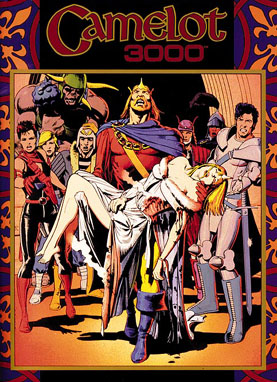
5. "Camelot 3000" by Mike Barr & Brian Bolland
It really doesn't get much better than Arthurian legend... unless you completely update the tale and set it in the year 3000. There is a legend that says when he is most needed, Arthur will rise again and liberate England. The Earth is being attacked by aliens from outer space. England is practically a desolate wasteland. That time is now. The first true 'maxiseries' in comics history, "Camelot 3000" was an epic work that was among the first comics to be considered for 'mature readers' due to its dealing with subjects like sexuality, adultery, and war. A classic when it was first released... and certainly still as relevant today.

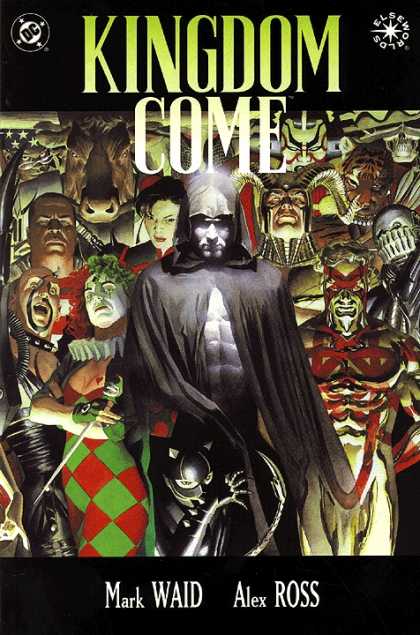
4. "Kingdom Come" by Mark Waid & Alex Ross
Taking a cue from an abandoned Alan Moore script called "Twilight of the Superheroes" (how's that for a Nietzschean allusion for you?), Waid and Ross put their heads together to create one of the best stories of the last twenty years. In a world that wants gritty, dark superheroes who aren't afraid to kill, superheroes like Superman and Batman have been passed off as obsolete. When a faithless pastor is called by the Spirit of Vengeance to oversee the end of the world, he watches helplessly as the heroes battle... while the fate of the earth hangs in the balance. Waid's words would only be half of the battle without Ross' photorealistic paints to set them off, however. My first major exposure to comics in general.

3. "The Dark Knight Returns" by Frank Miller
After an era where Batman had been battling farcical aliens on foreign worlds and fighting villains who employed giant typewriters as gimmicks, Frank Miller came along and made the Dark Knight a truly dark knight. Set forty years or so after the DCU of the '80s, "DKR" (as fans affectionately call it) sets an aging Bruce Wayne back into the spotlight to stand up against a Gotham overrun by gang violence and corruption. Miller humanized Batman, putting him at odds with old foes (like Two-Face and the Joker), law enforcement, and the government (including Reagan's lackey, Superman). Along with my #1 pick, this book is one of the two that has truly revitalized the industry.

2. "Maus: A Survivor's Tale" by Art Spiegelman
The true story of Auschwitz survivor Vladek Spiegelman (the author's father), "Maus" tells the story of a Polish Jew from before the beginning of the war up until the time it was written using anthropomorphic animals as characters. The Jews are depicted as mice, Germans as cats, French as frogs, Poles as pigs, Americans as dogs, etc. (For more information into the reasonings behind the animal usage, check the Wikipedia article.) Spiegelman himself struggles as he relates his father's tale, attempting to be simultaneously honest and sympathetic. What comes out of it is one of the great graphic novels of the 20th century.

1. "Watchmen" by Alan Moore & Dave Gibbons
Few graphic novels have both captured and challenged the imaginations of comic book fans quite like "Watchmen". The high mark on the list of two of comics' greatest legends, "Watchmen" is truly a feat, lending credence to comic books as a medium since its initial publishing in 1985. Twelve issues in length, Moore uses the murder of a masked avenger to uncover a conspiracy that, while deconstructing the superhero genre, deals with the human condition, war, belonging, impotence, and justice. Truly a love letter to the superhero genre (despite criticisms otherwise), Moore and Gibbons set out to answer the question, "What if superheroes really existed?" The answer is at once shocking, epic, humanizing, and meticulous. If you read one graphic novel in your life, make it "Watchmen".

Honorable mentions: "Batman: The Killing Joke" (Moore & Bolland), "From Hell" (Moore & Campbell), "V for Vendetta" (Moore & Lloyd), "300" (Miller), "Batman: The Long Halloween" (Loeb & Sale)

And now... comics series:

5. "Starman" by James Robinson & Tony Harris
Relying heavily on a time known as "The Golden Age of Comics" (i.e. 1930s-1940s), "Starman" tells the story of Jack Knight, the son of one of those 'Golden Age' heroes who reluctantly takes over for his aging father after his brother's death. We see Jack make the journey from reluctant hero to duty-bound man of honor as he battles for the love of his city, his family, and his love. Definitely playing on the 'legacy' aspect of the hero, Robinson incorporates various Starmen through history while never taking for granted that the reader may or may not know who they are. A well-written, well-executed arc from start-to-finish!

4. "The League of Extraordinary Gentlemen" by Alan Moore & Kevin O'Neill
Never mind the abysmal movie of the same name. "League" is one of the rare comic gems (and, coincidentally, Alan Moore's 'swan song' in the comic book field) that completely blows the reader's expectations and previous knowledge away. Characters from throughout literature - from Bram Stoker's Mina Harker to Jack Kerouac's Sal Paradise - are used as members of a team put together to fight the odd things in the world. With villains ranging from Fu Manchu to Big Brother, no literary character or device ever used is safe from Moore's deft touch. The best part? Moore is incredibly true to his source material, making "League" a great intro to someone who loves to read but has never much been into comics.

3. "Swamp Thing" by Alan Moore & Steve Bissette
I highly doubt that when Len Wein and Berni Wrightson created a man who turned into a living plant for a horror comic, they counted on him having such a massive cult following. It's really all thanks to comic book legend Alan Moore who turned him into the first major 'mature readers' ongoing title in comics history. Moore took the campy horror of "Swamp Thing" and made it real as his hero battled nightmare men and famous movie villains (from the wolfman to zombies). Moore also completely revamped the character's origin and, after removing all human traces from him whatsoever, sought to make this monster into a man... and did so to tremendous effect.

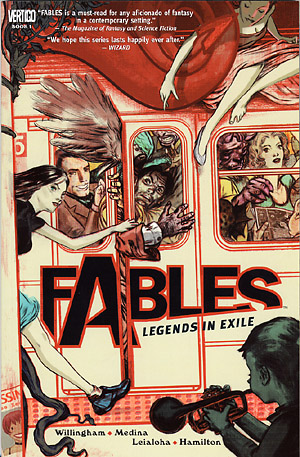
2. "Fables" by Bill Willingham & Mark Buckingham
Similar in execution to Moore's "League," imagine a world where all your favorite fairy tale characters had been run out of their enchanted homelands and were exiled in present day New York City. Imagine they had set up a government run by King Cole and Snow White. Imagine the Big Bad Wolf as town sheriff. Imagine Prince Charming as a mysoginistic ladies' man and Rose Red as a rebellious wild child. Imagine the Three Little Pigs as socialistic masterminds and Little Boy Blue as a war hero-turned-clerk. Imagine the Frog Prince as a janitor and a certain bridge troll as a doorman. Imagine all these things and so much more... and you might begin to see why "Fables" is one of the most original, fun, and (dare I say it?) imaginative titles to come along in ages!

1. "Sandman" by Neil Gaiman
What do you get when you combine one of the most imaginative writers working today with a plethora of the best artistic talent the comics industry has to offer? You get "Sandman," largely regarded to be the crowning acheivement of award-winning author Neil Gaiman. "Sandman" tells the story of Dream, one of the Endless - a group of seven siblings who have been around forever... and probably will be, too. From being imprisoned by a sorceror for the better part of a century to making a deal with William Shakespeare, from righting wrongs within his home, The Dreaming, to battling gods and faeries, Dream (a.k.a. Morpheus) is at once aloof and compassionate, alien and human. Another arc that runs from start to finish, Gaiman's "Sandman" is perfectly complete (and another of those runs that people who usually shun comics can appreciate for its sheer artistry).

Honorable mentions: "Bone" (Smith), "Top Ten" (Moore & Ha), "Authority" (Ellis & Hitch, Millar & Quitely), "Planetary" (Ellis & Cassaday), "Animal Man" (Morrison & Truog)

What are some of your favorite graphic novels and comics series?

Wednesday, August 6, 2008

Trader Joe's!

Last night, I went with my mom and sister to Trader Joe's up in Castleton. I've got to tell you - it was awesome! Over the past year, I've become more aware of Trader Joe's through the involvement of certain teacher friends over at CCHS. Over that time, I've tried a variety of their wares, including their Triple Ginger Snaps, their assortment of hard-to-find sodas (particularly Reed's Extra Ginger Brew), and an assortment of their cheeses.

Yesterday, though, was pretty sweet. I must've gone down every aisle two or three times, making sure I didn't miss anything. I got three kinds of nuts (Cinnamon Glazed Almonds, Honey Sesame Cashews, and Australian Macadamia Nuts), two kinds of turkey, some horseradish hummus, a brick of Dubliner cheese, a variety of condiments (like mustard and horseradish), and several other goodies! This may well be one of my new favorite places!

Tuesday, August 5, 2008

Hot Topic Tuesday - Deus Ex Machina Politica

I had wanted to start something like this last week, but just ran out of time, what with school starting up next week and all. The point of Hot Topic Tuesday is that most (hopefully) Tuesdays, I'll post my thoughts on a topic I've been thinking about - more than likely usually dealing with religion or politics or something else of that nature - and allow you to post your thoughts, should you feel so led.

This topic came from a conversation we had in the junior and senior Sunday School class at church on Sunday and I've had it in the back of my mind since. I call it:

Deus Ex Machina Politica
...which, translated from Latin, means "God from the Political Machine". The question I'm basically addressing here is, "How should Christians be involved in the political spectrum?" This, of course, opens up a variety of other questions: How should Christians vote? Should Chrisitians vote? Which issues are more important when choosing a political leader - moral or societal?
A number of years ago (I think it was during the last presidential election, actually), I posted a rant on Xanga called "God is not a Republican or a Democrat." I firmly hold that to be true. Whereas a few of my friends (perhaps one or two more than others) may find God to be incredibly Republican, I honestly don't think so...
One of the things that I find frustrating about the way Christians vote, by and large, is that there are really only one or two issues that concern them as a whole - abortion and gay marriage. If a candidate is not against both of these things, then he is either (a.) not a Christian, (b.) not getting their vote, or (c.) both. Christians tend to be pretty judgmental a lot of the time - particularly regarding these topics. I was once a part of a conversation where the other party said (and I'm paraphrasing here, since I don't remember it word for word), "If a candidate isn't about the rights of the unborn, then I don't want to listen to anything else they have to say."
I was a bit flabbergasted when I heard this to say the least. Mainly because I believe that abortion is not the only issue that Christians should be concerned with! There are the number of other issues: the environment, the death penalty, the War on Terror, social justice - both at home and abroad, foreign policy, the economy, education... the list goes on and on. And while a Christian may care about a number of these issues, it seems fair to say that most if not all of them take a back seat to the Big Two - abortion and gay marriage.
The thing is, both of these issues are moral issues rather than societal issues. In my mind, a candidate's morality shouldn't play as big a role as it has in the last few elections. After the outrage of the Lewinski scandal, it appears that many Christian Americans would rather have a president that is morally upstanding than a president who would make a strong leader. I'm not sure that the two are mutually exclusive, myself.
The junior/senior Sunday School teacher made a great point Sunday morning. He said that societal issues are more about how the country is being run now. Getting us out of present crises like the current economic crunch or the War on Terror. Moral issues are about the countries future and how the 'moral barometer' of the nation will tilt. Moral issues didn't really concern the Founding Fathers... mainly because they were on the same page about a lot of things. It was assumed that everyone believed in God and, for the most part, would behave a certain way.
Over time, that's changed. For good or ill? I'll leave that up to you.
I think both moral and societal issues are important. That may not have come across in this 'rant,' but it is true. I think that Christians, however, should have a consistent ethic. They should be of a like mind of Christ. That might mean going back and reading through the gospels and then asking some hard questions: How can killing prisoners or soldiers be okay and killing babies be wrong? Is it okay to be the wealthiest nation on earth while people in other countries are dying of disease and starvation? Are religion and science mutually exclusive?
These are tough questions, to be sure, but - I feel - definitely worth thinking about and, should the inclination strike you, answering.
Thoughts? Comments? Counter-rants?

Monday, August 4, 2008

The Recipe That Never Followed

D'oh! Forgot I was gonna give you this recipe!

Bacon-Wrapped Shrimp

Ingredients:

  • A couple pounds of 8-12 shrimp (You can get smaller sizes, but I've found bigger shrimp to work best. I also like to get the unpeeled shrimp from the seafood department and skin them all myself. Just a matter of preference, really.)
  • A package of good quality bacon (I love to use Boar's Head bacon, which is smoked and thick, giving a great flavor to the shrimp. It's also organic. Huzzah! You'll want a 2:1 shrimp-to-bacon ratio - that is, two shrimp per strip of bacon. For smaller shrimp, I use a 3:1 ration.)
  • Salt and pepper for seasoning

Preparation:

  1. Peel and devein your shrimp, leaving the tail (for handling purposes).
  2. Season your shrimp with salt and pepper (usually just on one side works for me).
  3. Count out the amount of bacon you need based on number of shrimp. (Remember the 2:1 ratio. For one and a half pounds of 8-12 shrimp, I used nine pieces of bacon.)
  4. Cut the bacon in half (or, if you're using smaller shrimp, in thirds).
  5. Wrap the bacon strips around the seasoned shrimp, securing them with a toothpick.
  6. Place the wrapped shrimp on a cookie sheet and under the broiler at about 350 degrees. Cook for about five minutes on each side (though larger shrimp may need to cook longer).
  7. Serve on a platter with homemade cocktail sauce (recipe below).

Homemade Cocktail Sauce

Ingredients:

  • 1 c. ketchup
  • 1/2 c. prepared horseradish (You can add more or less depending on how spicy you like it. I end up adding almost as much horseradish as I do ketchup!)
  • 1 1/2 tsp. worchestershire sauce (I like Lea & Perrins.)
  • Zest of 1 lemon
  • Juice of 1/2 lemon
  • 2-3 drops of hot sauce (I like to use Frank's Red Hot, but Tabasco, Louisiana, or Cholula would work just as well.)
  • Salt and pepper for seasoning

Preparation:

  1. Combine all ingredients and stir together. Let sit in your refrigerator for an hour or two before serving to allow the flavors to come together.

Note: Make sure you taste your cocktail sauce for desired spice before serving. If you think a half-cup of horseradish is too much, start with a quarter cup and add more as needed. Tailor it to your tastes rather than mine. Me? I like it spicy... but not everyone else will necessarily.

Already off to a bad start...

I've had this blog a little over a week and already, I've gotten lax on posting promised things. I promise to make the Top Five up to you next Friday.

In fairness, though, this week has been quite busy. My buddy Matt got married this weekend to my friend Amanda. I was the best man... which was a LOT of fun, but also a LOT of work!

After the rehearsal dinner Friday night (at this great Italian restaurant in downtown Indy called Amici's), I had all the guys that came up for the wedding (9 in all) over to my place for the 'bachelor party'. I have to say... it was a blast! I made a bunch of my famous bacon-wrapped shrimp with homemade cocktail sauce (recipe to follow), which went really fast! I think everyone got their fill, though! Matt's brother Ben went out and rented Rambo which we 'watched' (I use the term loosely because most of the time, we were making fun of Rambo's unintelligible, monosyllabic speech patterns or the mindless violence dolled out so easily). All in all, we just hung out and enjoyed each other's company, which was SO much fun! We really got a chance to just relax.

After Rambo, Matt's three brothers split and the rest of us (groom, groomsmen, and Matt's friend Daniel) slept over at my place. The next morning, I got up and made homemade waffles with my Belgian waffle iron and coffee in my new French press! I also fried up the bacon that remained after the bacon-wrapped shrimp were finished. It was quite tasty!

Then... SET-UP! The males spent almost the entire day setting up for the wedding... and since it was an outdoor wedding, there was a lot to do! Putting in stakes to hang flowers from, putting up tents for shade, setting up chairs, filling up balloons... we were out there for about four hours or so! We got there at 10:45-ish (well, me and my group did) and pictures didn't get started 'til around 4:00-ish.

Outdoor wedding in August - HOT... but still not as hot as it could have been. The temp was around 90, which for an August day in Indy, isn't that bad. We wore our jackets (my fault - I told Matt I could handle it), but fortunately the ceremony was only about 10 minutes long. It was a really great ceremony too. Matt's dad officiated and was funny, endearing, and sniffle-inducing. He made Amanda cry, which is saying something.

The food was great, too. Matt and Amanda served all the guests personally, which I thought was a great take on the receiving line concept. They also had matching "Bride" and "Groom" aprons. There was chicken cordon-bleu (or chicken stuffed with cheese and broccoli), twice-baked potatoes, fruit, salad, Italian bread, and some awesome mixed veggies. There was a huge assortment of cakes as well, none of which I got to try because I was out...

DECORATING THE CAR! One of my favorite parts of being a groomsman has always been decorating the transport to the honeymoon! One of the groomsmen, Chris, and I went out Saturday afternoon and grabbed a bunch of stuff from Wal-Mart to decorate the car. I won't go into details, but the end result was quite humorous and (for the most part) enjoyed by all in attendance. A job well done, I think!

Got in late Saturday night and got up early Sunday morning. With the little sleep I'd gotten on Friday and the crazy hectic Saturday, I was really starting to feel the strain. Two Sunday School classes later, and 30+ members of the youth group are sitting around several tables at the Buffalo Wild Wings in the Washington Square Mall to send off our summer intern, Jon Kundrat. When he first came to Indy First at the beginning of the summer, I took him out to B-Dubs as a way of welcoming him (the youth pastor was gone that Sunday, so I was in charge). So, someone thought it would be a good idea to send him off on his last Sunday the same way... only this time, invite the whole youth group! It was a great time of spicy wings, great fellowship, and competative trivia gaming! (I won two of the six games I played!)

After turning in the tuxes from the day before and stopping by the comic book store, I returned home at about 4:30 for a nap... which lasted only about an hour, but still managed to rest me. I got a call from Matt's older brother Dan (with whom I roomed for a semester in college) and his wife, Mary Kay (another dear friend from Olivet) who wanted to hang out. So, we went in style! We went to Stir Crazy, one of my favorite new restaurants. They serve Asian fusion cuisine - and have some great dishes! I tried the market bar for the first time... and have to say I really enjoyed it! It's basically set up Mongolian style... and you get to choose all your veggies and sauces and make a custom dish that's really quite a unique experience! I got some Szechwan shrimp with pea pods, squash, bell peppers, chili peppers, mushrooms, onions, ginger, and garlic. And, of course, we finished off with dessert! I got their signature Pyphoon while Mary Kay got the Chocolate Fondue - both awesome!

Then we decided to go see Baby Mama in the dollar theater in Greenwood. It was alright - very funny in places, but a bit formulaic and just not what any of us were expecting out of Tina Fey. Steve Martin was very funny, as were Amy Poehler and Greg Kinnear... but just not a great movie, all in all.

Well, that's all for my weekend. Hopefully, I'll be able to update tomorrow with a feature I'd like to call Hot Topic Tuesday!