
I've long been a comic reader, but didn't become a fan until I got into high school. I find myself really drawn to epic storylines with some great artwork more than I am to the 'pop' comic stuff (which is a lot of what the superhero fare is these days - stuff like 'Superman,' 'Batman,' and 'Green Lantern'). That being the case, I tend to like stuff that skews a bit darker.
Below is a list of my top five favorite graphic novels and comics series. What's the difference? Graphic novels are typically limited series - one-shots, miniseries, or maxiseries - combined into one volume, whereas a series is an extended run which is often collected into several graphic novels. Therefore, graphic novels first:
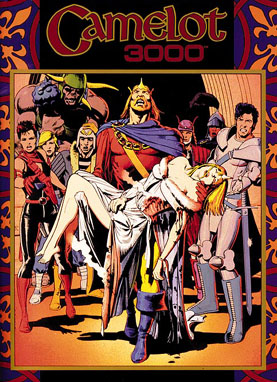
It really doesn't get much better than Arthurian legend... unless you completely update the tale and set it in the year 3000. There is a legend that says when he is most needed, Arthur will rise again and liberate England. The Earth is being attacked by aliens from outer space. England is practically a desolate wasteland. That time is now. The first true 'maxiseries' in comics history, "Camelot 3000" was an epic work that was among the first comics to be considered for 'mature readers' due to its dealing with subjects like sexuality, adultery, and war. A classic when it was first released... and certainly still as relevant today.
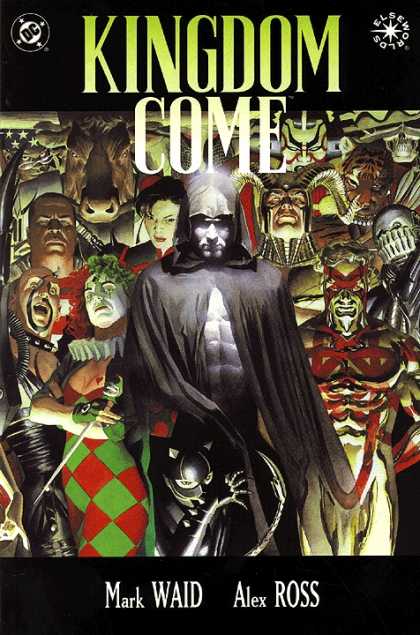
Taking a cue from an abandoned Alan Moore script called "Twilight of the Superheroes" (how's that for a Nietzschean allusion for you?), Waid and Ross put their heads together to create one of the best stories of the last twenty years. In a world that wants gritty, dark superheroes who aren't afraid to kill, superheroes like Superman and Batman have been passed off as obsolete. When a faithless pastor is called by the Spirit of Vengeance to oversee the end of the world, he watches helplessly as the heroes battle... while the fate of the earth hangs in the balance. Waid's words would only be half of the battle without Ross' photorealistic paints to set them off, however. My first major exposure to comics in general.
 3. "The Dark Knight Returns" by Frank Miller
After an era where Batman had been battling farcical aliens on foreign worlds and fighting villains who employed giant typewriters as gimmicks, Frank Miller came along and made the Dark Knight a truly dark knight. Set forty years or so after the DCU of the '80s, "DKR" (as fans affectionately call it) sets an aging Bruce Wayne back into the spotlight to stand up against a Gotham overrun by gang violence and corruption. Miller humanized Batman, putting him at odds with old foes (like Two-Face and the Joker), law enforcement, and the government (including Reagan's lackey, Superman). Along with my #1 pick, this book is one of the two that has truly revitalized the industry.
 2. "Maus: A Survivor's Tale" by Art Spiegelman
The true story of Auschwitz survivor Vladek Spiegelman (the author's father), "Maus" tells the story of a Polish Jew from before the beginning of the war up until the time it was written using anthropomorphic animals as characters. The Jews are depicted as mice, Germans as cats, French as frogs, Poles as pigs, Americans as dogs, etc. (For more information into the reasonings behind the animal usage, check the Wikipedia article.) Spiegelman himself struggles as he relates his father's tale, attempting to be simultaneously honest and sympathetic. What comes out of it is one of the great graphic novels of the 20th century.
 1. "Watchmen" by Alan Moore & Dave Gibbons
Few graphic novels have both captured and challenged the imaginations of comic book fans quite like "Watchmen". The high mark on the list of two of comics' greatest legends, "Watchmen" is truly a feat, lending credence to comic books as a medium since its initial publishing in 1985. Twelve issues in length, Moore uses the murder of a masked avenger to uncover a conspiracy that, while deconstructing the superhero genre, deals with the human condition, war, belonging, impotence, and justice. Truly a love letter to the superhero genre (despite criticisms otherwise), Moore and Gibbons set out to answer the question, "What if superheroes really existed?" The answer is at once shocking, epic, humanizing, and meticulous. If you read one graphic novel in your life, make it "Watchmen".
Honorable mentions: "Batman: The Killing Joke" (Moore & Bolland), "From Hell" (Moore & Campbell), "V for Vendetta" (Moore & Lloyd), "300" (Miller), "Batman: The Long Halloween" (Loeb & Sale)
And now... comics series:
 5. "Starman" by James Robinson & Tony Harris
Relying heavily on a time known as "The Golden Age of Comics" (i.e. 1930s-1940s), "Starman" tells the story of Jack Knight, the son of one of those 'Golden Age' heroes who reluctantly takes over for his aging father after his brother's death. We see Jack make the journey from reluctant hero to duty-bound man of honor as he battles for the love of his city, his family, and his love. Definitely playing on the 'legacy' aspect of the hero, Robinson incorporates various Starmen through history while never taking for granted that the reader may or may not know who they are. A well-written, well-executed arc from start-to-finish!
 4. "The League of Extraordinary Gentlemen" by Alan Moore & Kevin O'Neill
Never mind the abysmal movie of the same name. "League" is one of the rare comic gems (and, coincidentally, Alan Moore's 'swan song' in the comic book field) that completely blows the reader's expectations and previous knowledge away. Characters from throughout literature - from Bram Stoker's Mina Harker to Jack Kerouac's Sal Paradise - are used as members of a team put together to fight the odd things in the world. With villains ranging from Fu Manchu to Big Brother, no literary character or device ever used is safe from Moore's deft touch. The best part? Moore is incredibly true to his source material, making "League" a great intro to someone who loves to read but has never much been into comics.
 3. "Swamp Thing" by Alan Moore & Steve Bissette
I highly doubt that when Len Wein and Berni Wrightson created a man who turned into a living plant for a horror comic, they counted on him having such a massive cult following. It's really all thanks to comic book legend Alan Moore who turned him into the first major 'mature readers' ongoing title in comics history. Moore took the campy horror of "Swamp Thing" and made it real as his hero battled nightmare men and famous movie villains (from the wolfman to zombies). Moore also completely revamped the character's origin and, after removing all human traces from him whatsoever, sought to make this monster into a man... and did so to tremendous effect.
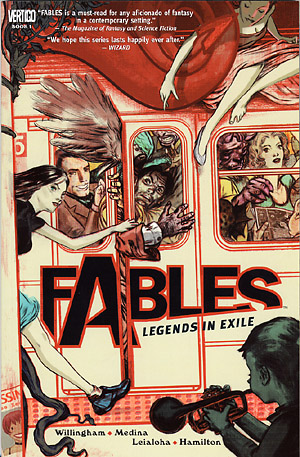 2. "Fables" by Bill Willingham & Mark Buckingham
Similar in execution to Moore's "League," imagine a world where all your favorite fairy tale characters had been run out of their enchanted homelands and were exiled in present day New York City. Imagine they had set up a government run by King Cole and Snow White. Imagine the Big Bad Wolf as town sheriff. Imagine Prince Charming as a mysoginistic ladies' man and Rose Red as a rebellious wild child. Imagine the Three Little Pigs as socialistic masterminds and Little Boy Blue as a war hero-turned-clerk. Imagine the Frog Prince as a janitor and a certain bridge troll as a doorman. Imagine all these things and so much more... and you might begin to see why "Fables" is one of the most original, fun, and (dare I say it?) imaginative titles to come along in ages!
 1. "Sandman" by Neil Gaiman
What do you get when you combine one of the most imaginative writers working today with a plethora of the best artistic talent the comics industry has to offer? You get "Sandman," largely regarded to be the crowning acheivement of award-winning author Neil Gaiman. "Sandman" tells the story of Dream, one of the Endless - a group of seven siblings who have been around forever... and probably will be, too. From being imprisoned by a sorceror for the better part of a century to making a deal with William Shakespeare, from righting wrongs within his home, The Dreaming, to battling gods and faeries, Dream (a.k.a. Morpheus) is at once aloof and compassionate, alien and human. Another arc that runs from start to finish, Gaiman's "Sandman" is perfectly complete (and another of those runs that people who usually shun comics can appreciate for its sheer artistry).
Honorable mentions: "Bone" (Smith), "Top Ten" (Moore & Ha), "Authority" (Ellis & Hitch, Millar & Quitely), "Planetary" (Ellis & Cassaday), "Animal Man" (Morrison & Truog)
What are some of your favorite graphic novels and comics series?



 Posts
Posts


