
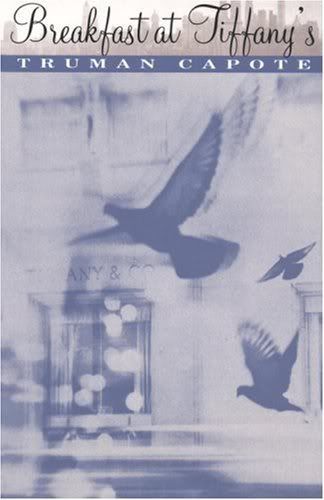
 5. Breakfast at Tiffany's by Truman Capote
In Cold Blood was some of my first exposure to the writing of Truman Capote since I was forced to read his short story "A Christmas Memory" in middle school. (And, since I didn't like anything I read in middle school - because I was being forced to read it in middle school - it was a futile endeavor.) However, after reading In Cold Blood, I felt inspired to pick up some of Capote's other writings. Breakfast at Tiffany's was the first. I was amazed at Capote's use of prose - its poetic nature and fluid rhythm, almost as if it were a living thing in and of itself. I am consistantly enamored with his writing and think it a shame he didn't stick around to write more.
 4. Brave New World by Aldous Huxley
I read Brave New World my senior year in high school and absolutely loved it! My reading of it followed my reading of Sir Thomas More's Utopia, Orwell's 1984, and Postman's Amusing Ourselves to Death, so I was already fascinated by the concept of dystopia - a society which seems perfect to a degree, but falls apart when the surface is scratched or upset in any way. Huxley BNW defied my prior notions of a dystopia largely because of its characters are unaware of the flaws inherent in the society. In his nightmarish vision, Huxley paints a society so close to the one in which we live, it's almost frightening.
 3. American Gods by Neil Gaiman
I had heard Gaiman's name mentioned before, namely in comic circles as the author of the series The Sandman. Other than that, I knew nothing of him before I picked up American Gods one summer night during my high school days. One of the first things I noticed was that it was epic in scope. Indeed, the book had a cast in the dozens (with many more unnamed besides) and told a story that stretched across centuries and continents, written in a style that is at once self-aware and unassuming. Gaiman reveals himself a master story-teller in both this and its sequel, the novella The Monarch of the Glen. If you've not read either, do yourself a favor.
 2. Alice's Adventures in Wonderland by Lewis Carroll
Like many, my first exposure to Carroll's wonderful creations was Disney's animated classic Alice in Wonderland. In fact, it wasn't until high school (when I read Carroll selections for speech tournaments) that I discovered the amazing text pieces the film had been based on - Adventures and its sequel, Through the Looking Glass and What Alice Found There. They were so different from Disney's version, which made them so compelling. With rich characters and oddly absurdist thinking, it became no wonder to me that Alice (and Carroll) had successfully captured the imaginations of so many for so long.
 1. 1984 by George Orwell
No other book has elicited such a response from me. Read not for class but of my own volition (a rare feat for me in high school... at least with regard to a classic piece of literature), I found 1984 haunting, disturbing, and compelling. I connected well with its main character and, as such, was upset by the course of action within the book. A thinly-veiled indictment of Communism, Orwell's masterpiece has stood the test of time as a chilling work regarding both the role of government and free will.
Honorable mentions: Watchmen (Moore & Gibbons), The Reluctant Fundamentalist (Hamid), Waiting for Godot (Beckett), Sophie's World (Gaarder), Cat's Cradle (Vonnegut)
*NOTE* - I have actually not read Harper Lee's To Kill a Mockingbird, which I know is a literary heresy. It's on my list of "books to read," but know that it's exclusion on this list is mainly due to that fact.
So... what are some of your favorite fiction titles?



 Posts
Posts


